
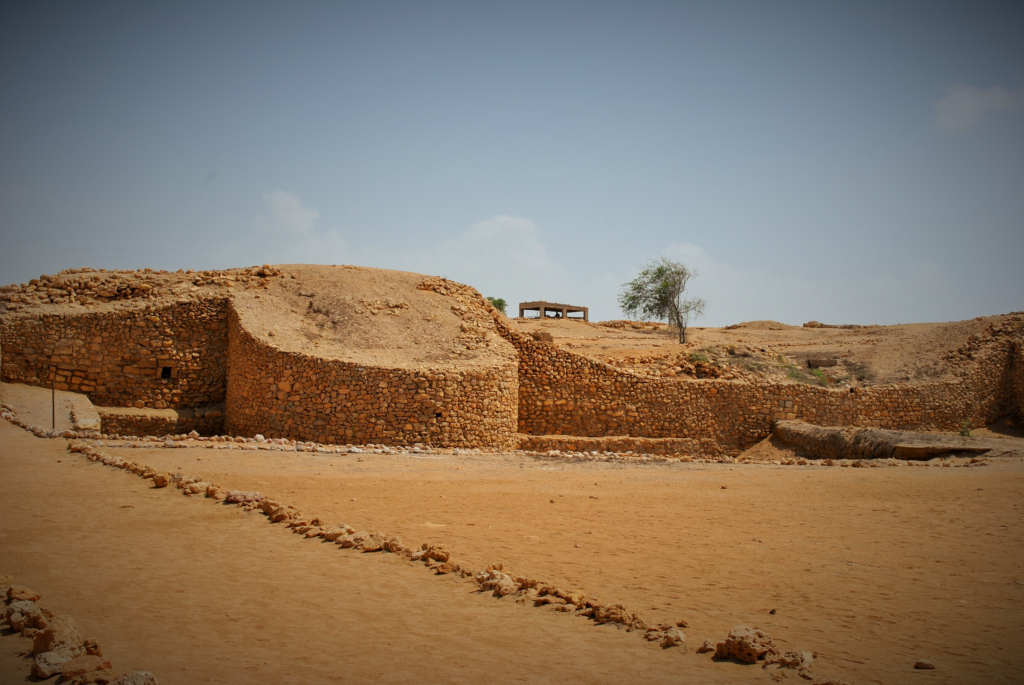
About 65 kilometres from Karachi, beside the waters of Gharo Creek, lie the Bhanbhore Ruins, one of the most important archaeological sites in Sindh.
Also written as Banbhore, Bhambore or Bhambhore, the site preserves evidence of settlement from approximately the first century BC to the early 13th century AD. Its fortification walls, bastions, streets, industrial areas, religious structures and archaeological finds reveal the remains of a city that once stood between inland Sindh and the maritime routes of the Indian Ocean.
Bhanbhore is also widely associated with Debal, the historic port connected with Muhammad bin Qasim’s campaign in Sindh in the early eighth century. Although that identification remains debated among historians and archaeologists, Bhanbhore’s importance as an ancient and medieval port settlement is well established through archaeology.
The site also occupies a special place in Sindhi cultural memory through its association with Sassui, heroine of the famous love story of Sassui and Punhun.
For travelers interested in archaeology, Sindhi history, maritime trade and historical places near Karachi, Bhanbhore provides a fascinating introduction to more than a thousand years of settlement in the Indus Delta.
Location and Historical Setting of Bhanbhore
Bhanbhore stands on the northern bank of Gharo Creek in Thatta District, approximately 64 to 65 kilometres from Karachi.
Its location is central to understanding why the settlement developed here. Bhanbhore stood close to waterways associated with the Indus Delta, where river channels and coastal creeks historically connected inland Sindh with maritime routes leading into the Arabian Sea and Indian Ocean.
This geographical position allowed the settlement to participate in regional and long-distance trade while remaining connected with agricultural and urban areas farther inland.
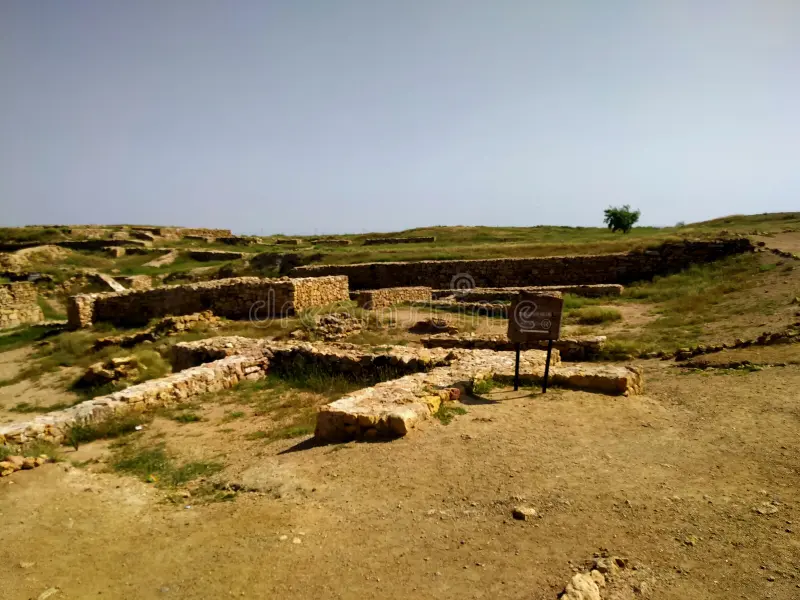
Today, Gharo Creek appears relatively quiet, but Bhanbhore’s fortifications, suburbs, reservoir and industrial remains show that this was once a substantial and organised urban centre.
History and Archaeological Development of Bhanbhore
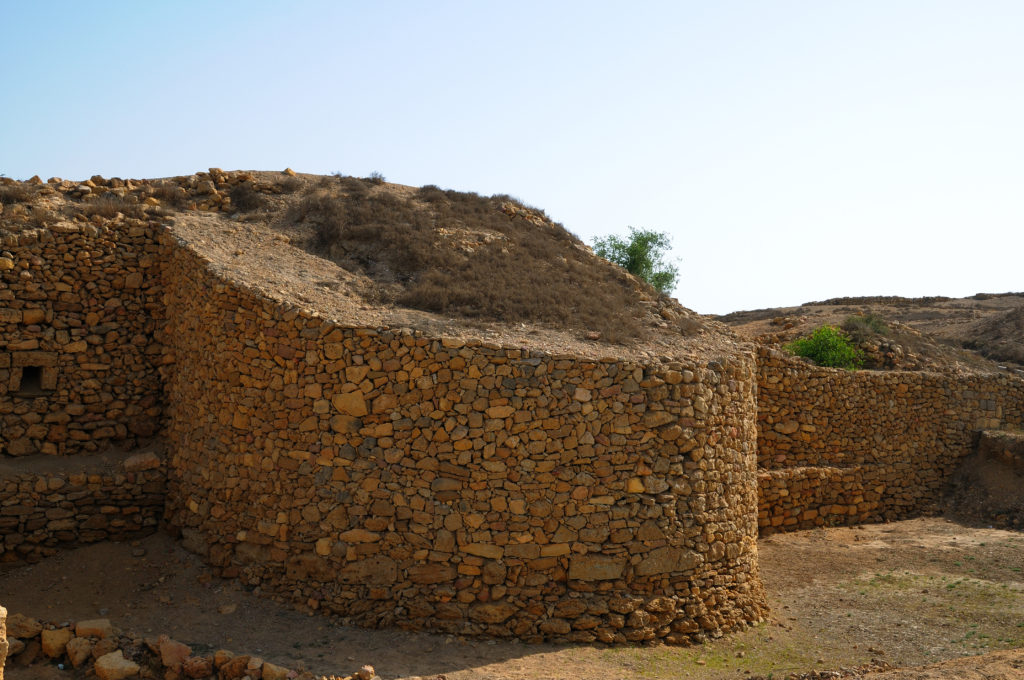
Archaeological evidence at Bhanbhore records a long sequence of occupation from approximately the first century BC to the early 13th century AD.
The earliest levels are generally associated with the Scytho-Parthian period. Later pre-Islamic phases produced pottery, architectural fragments and other material associated with changing cultural traditions in Sindh.
Some carved stone associated with earlier Hindu structures was subsequently reused in Islamic-period buildings. This reuse demonstrates how parts of the settlement were adapted rather than simply abandoned whenever political or religious conditions changed.
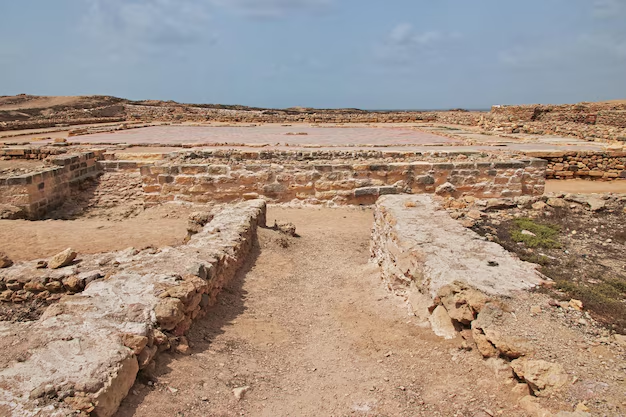
The Islamic period produced many of the surface remains visible today. Bhanbhore developed as a fortified urban settlement with streets, residential areas, public buildings, manufacturing activity and a large religious structure traditionally identified as the Grand Mosque.
Modern archaeological excavation began in March 1958 and continued through several seasons into the 1960s. These excavations exposed the fortifications, street plan, residential areas, industrial zones and mosque complex while recovering pottery, glass, coins, inscriptions and other artefacts belonging to different periods of occupation.
Bhanbhore is therefore best understood not as a city built during a single historical period, but as a settlement that developed, changed and was rebuilt over many centuries.
Bhanbhore and the Ancient Port of Debal
One of the most important historical questions surrounding Bhanbhore is whether the site represents the ancient port of Debal, also written as Daybul or Daibul.
Debal appears in early historical accounts as an important port of Sindh and is particularly associated with the campaign of Muhammad bin Qasim during the reign of Raja Dahir. Traditional accounts place the capture of Debal around 711 to 712 AD.
Bhanbhore has long been proposed as the location of this historic port. Its position near the Indus Delta, substantial fortifications, maritime character and occupation during the relevant historical period all support the association. Official Sindh heritage descriptions also connect the archaeological site with Debal.
However, the identification is not conclusively proven.
No inscription discovered at Bhanbhore has definitively named the settlement as Debal, and historians and archaeologists have debated how descriptions in early geographical texts correspond with the changing landscape of the Indus Delta.
The most accurate description is therefore that Bhanbhore is widely identified with the historic port of Debal, but the identification remains a subject of scholarly debate.
That uncertainty does not reduce the importance of Bhanbhore. Instead, it makes the site central to an ongoing archaeological and historical discussion about the early ports of Sindh.
Fortifications and Urban Layout
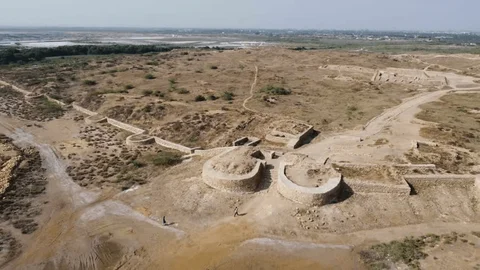
The principal fortified mound at Bhanbhore measures approximately 610 metres by 305 metres and rises around 10 metres above the surrounding landscape.
A limestone defensive wall approximately three metres wide surrounded the main settlement. Official archaeological descriptions record:
- 46 rounded bastions
- Three gateways
- A grid-like arrangement of streets
- An interior wall dividing parts of the settlement
- A major religious structure
- An administrative quarter
- A serai, or inn
Outside the main fortifications were substantial unfortified suburbs. A large artificial reservoir supplied drinking water, while an industrial area contained evidence of manufacturing activity.
The combination of fortifications, public buildings, residential quarters, water management and industry demonstrates that Bhanbhore was not simply a military fort. It was a complex urban settlement with administrative, commercial, industrial and religious functions.
The Grand Mosque of Bhanbhore
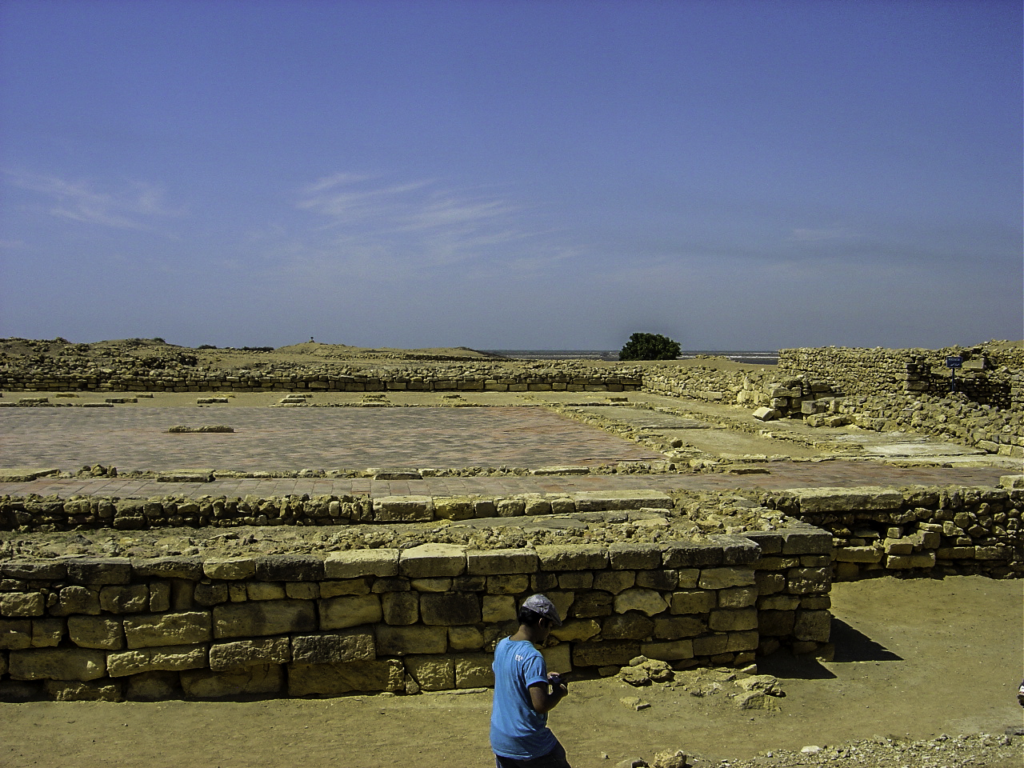
One of the best-known archaeological structures at Bhanbhore is the building traditionally identified as the Grand Mosque of Banbhore.
Its surviving plan measures approximately 34 metres by 35 metres, with a central open courtyard surrounded by covered areas. The western section has traditionally been identified as the prayer hall, where a flat roof was supported by 33 wooden pillars resting on sandstone bases.
Although little of the upper structure survives, the foundations and pillar bases allow visitors to understand the general arrangement of the building.
Dating the Mosque and Its Inscriptions
The chronology of the Bhanbhore mosque is more complicated than a single date might suggest.
UNESCO’s official Tentative List description refers to an inscription dated to 727 AD, around 109 AH, and uses this evidence in describing Bhanbhore as an important example of an early mosque in the region.
Archaeological publications also record other Kufic inscriptions from the mosque area.
In S. M. Ashfaque’s 1969 study, “The Grand Mosque of Banbhore,” a stone slab bearing the date 239 AH, corresponding to 853 to 854 AD, is described as having been reused as the base of a wooden column in the south-western corner of the courtyard.
This distinction is important.
The 239 AH inscription confirms that a dated inscribed stone was present and reused within the mosque complex, but it does not by itself prove that the mosque was built in 853 to 854 AD. Because the stone was reused, its date cannot automatically be treated as the construction date of the building.
Other inscriptions from the mosque area, including one dated to 294 AH, further demonstrate that the structure and its surroundings experienced activity and modification over time.
Later archaeological scholarship has also reconsidered the building’s chronology, architectural phases and earliest interpretation.
The safest conclusion is therefore that Bhanbhore preserves an important early Islamic religious complex whose precise chronology and different building phases remain subjects of archaeological discussion.
It would be misleading to state categorically that the mosque itself was built either in 727 AD or in 853 to 854 AD based solely on the inscriptions.
The Missing Mihrab
Official archaeological descriptions also record that no trace of a mihrab was found in the western wall.
A mihrab normally marks the direction of prayer in a mosque, and its absence has contributed to discussion about the development and interpretation of the building.
Later research has suggested that damage, rebuilding and different architectural phases may complicate interpretation of the western wall.
The missing mihrab should therefore be considered part of the wider archaeological discussion rather than treated as proof of one particular explanation.
Maritime Trade, Industry and Daily Life
Bhanbhore’s location near the Indus Delta placed it within the wider commercial world of the Indian Ocean.
Archaeological discoveries include glazed pottery, glassware, coins, storage vessels, metal objects, ivory and imported ceramics. The Bhanbhore Museum records Chinese pottery dating from approximately the ninth to 12th centuries.
The presence of Chinese ceramics does not necessarily mean that ships travelled directly between China and Bhanbhore. Ancient maritime commerce frequently operated through networks of ports and intermediaries.
These discoveries instead show that goods produced in distant regions reached Bhanbhore through long-distance commercial networks.
Bhanbhore was also a centre of production. Archaeologists identified evidence of:
- Textile processing
- Glass-making
- Glazing
- Metallurgy
This combination of imported goods and local manufacturing helps explain the importance of the settlement. Merchants, craftsmen, administrators and residents all formed part of its urban economy, while the reservoir, workshops and residential areas supported daily life within and around the fortified city.
Decline of Bhanbhore as a Port
Bhanbhore’s decline was closely connected with the changing geography of the Indus Delta.
UNESCO’s description states that the settlement’s role as a port ended when the Indus shifted during the 11th century and the creek silted up.
For a maritime settlement, losing reliable access to navigable waterways would have had serious economic consequences. Commercial traffic would increasingly have moved towards other channels and ports.
However, the end of Bhanbhore’s importance as a port should not be confused with the immediate abandonment of the entire settlement.
Archaeological occupation at the wider site continued into the early 13th century.
Its decline is therefore better understood as a gradual process shaped by environmental change, shifting trade routes and changing economic conditions rather than a single sudden event.
Bhanbhore and Love Story of Sassui-Punhun
Bhanbhore is important not only for archaeology but also for Sindhi cultural tradition.
In the famous romance of Sassui and Punhun, Bhambore is associated with Sassui, one of Sindh’s best-known legendary heroines.
Different versions of the story survive. In one widely told tradition, Sassui is abandoned as an infant and is eventually raised by a washerman in Bhambore.
She later falls in love with Punhun, a prince associated with Kech in Makran.
Punhun’s family opposes the relationship and eventually takes him away. Sassui sets out across the harsh landscape in search of him, beginning a journey that ends tragically.
The story became particularly important through the poetry of Shah Abdul Latif Bhittai.
In his Sufi poetic tradition, Sassui’s journey represents more than romantic devotion. Her search becomes a symbol of endurance, longing and the soul’s difficult journey towards the beloved.
The connection between Sassui and Bhambore belongs to folklore and literary tradition rather than archaeologically documented history.
That distinction is important, but it does not diminish the story’s significance to the cultural identity of the site.
Archaeological Museum of Bhanbhore
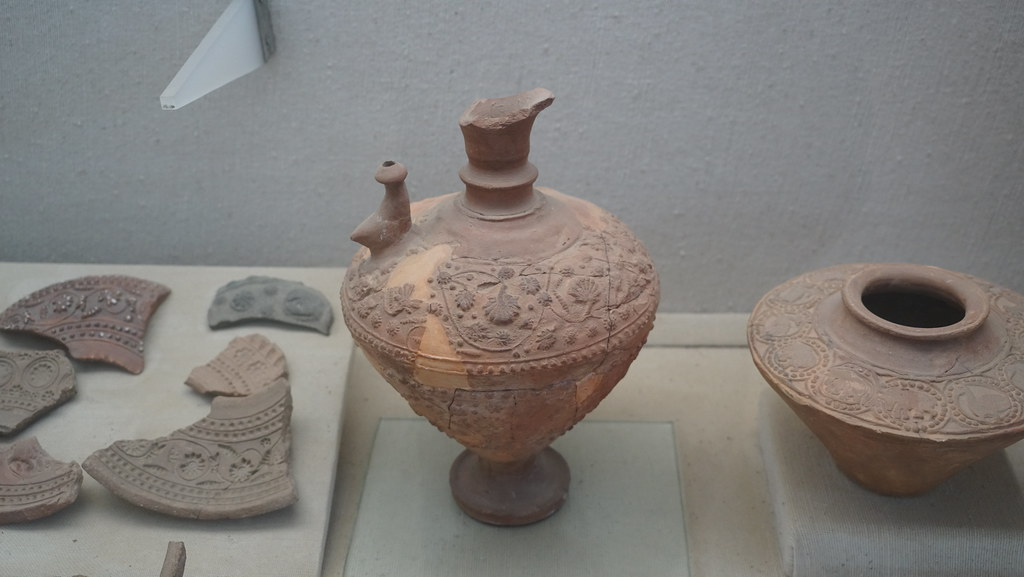
The Bhanbhore Archaeological Museum provides valuable context for the ruins outside.
Its published collections represent several periods of occupation and include:
- Scytho-Parthian pottery
- Sassanian stamped and moulded pottery
- Material associated with the Brahmanical period
- Storage jars and white-paste pottery from the Islamic period
- Glass objects
- Glazed pottery with Kufic inscriptions
- Chinese pottery from approximately the ninth to 12th centuries
- Coins and objects made from iron, copper and ivory
The museum helps visitors understand how archaeologists reconstruct the history of Bhanbhore from objects found during excavation.
Pottery reveals aspects of everyday activity and changing cultural connections. Coins contribute to the study of chronology and commerce. Inscriptions provide evidence relating to religion, language and building history, while imported ceramics demonstrate participation in long-distance trading networks.
Visitors with a strong interest in history may find it useful to see the museum before exploring the archaeological remains.
UNESCO Status of the Port of Banbhore
Bhanbhore is not currently an inscribed UNESCO World Heritage Site.
The Port of Banbhore was added to Pakistan’s UNESCO World Heritage Tentative List on 30 January 2004 under cultural criteria (iv), (v) and (vi).
A Tentative List is an inventory of properties that a country may consider nominating to the World Heritage List.
Inclusion on the Tentative List is therefore significant, but it is not the same as official World Heritage inscription.
UNESCO’s description highlights the site’s early Islamic urban remains, medieval port, fortification system, mosque complex, industrial areas and connections between maritime commerce and inland Sindh.
Pakistan’s September 2026 UNESCO Initiative
On 2 September 2026, the Government of Pakistan’s Press Information Department announced that Pakistan had requested UNESCO to facilitate the inclusion of the Port of Banbhore and Ranighat in the World Heritage List.
According to the official government announcement, the Federal Minister for National Heritage and Culture also sought UNESCO’s assistance in advancing Pakistan’s heritage nominations and conservation efforts.
This represented an official request for assistance.
It did not mean that UNESCO had approved or inscribed Bhanbhore as a World Heritage Site.
Bhanbhore’s current official status remains UNESCO World Heritage Tentative List.
Bhanbhore Ruins Visitor Information
Bhanbhore is an open archaeological site, so visitors should expect exposed foundations, walls, uneven ground and limited shade rather than a fully reconstructed monument.
Published Opening Hours
The Directorate General of Antiquities and Archaeology, Government of Sindh, currently publishes opening hours of:
9:00 AM to 5:00 PM
There is, however, a discrepancy between its official pages.
The Banbhore Fort page states that the site and museum are open seven days a week, while the separate Archaeological Museum Banbhore page states that archaeological museums are open six days a week and are closed on Wednesday.
Visitors who specifically want to see the museum should therefore check the latest official Government of Sindh visitor information before travelling.
Published Ticket Prices
The official Archaeological Museum Banbhore information currently lists:
| Visitor | Published Rate |
| Pakistani adult | Rs 50 |
| Child aged 6 to 12 | Rs 30 |
| Foreign visitor | Rs 1,500 |
These are published government rates and may change.
Visitors should review the latest official Government of Sindh information before travelling for current entry fees and opening arrangements.
The official museum information also lists a booking office and book shop at the main entrance.
Visitors should carry drinking water, sun protection, comfortable walking shoes and sufficient cash.
Best Time to Visit Bhanbhore Ruins
The cooler months from November to February are generally the most comfortable period for exploring Bhanbhore.
Much of the archaeological site is exposed and shade is limited. October and March may also be suitable, particularly with an early start.
During warmer months, the heat and humidity of southern Sindh can make prolonged outdoor exploration difficult.
Visitors should carry adequate water, wear sun protection and avoid spending unnecessary time on the exposed mound during the hottest part of the day.
Checking the weather forecast before travelling is recommended.
How to Reach Bhanbhore from Karachi
Bhanbhore lies around 64 to 65 kilometres from Karachi in the direction of Gharo and Thatta.
The most convenient option for most visitors is a private vehicle. The road journey heads east from Karachi towards Dhabeji and Gharo before reaching the archaeological site.
Travel time varies depending on the starting point in Karachi and traffic conditions, so it is better not to treat one journey time as guaranteed.
Public transport operates along the Karachi to Thatta corridor, but additional arrangements may be required to reach the archaeological site and return conveniently.
Travelers planning to combine Bhanbhore with other heritage sites generally have greater flexibility with a private vehicle or guided excursion.
Bhanbhore, Chaukhandi, Makli and Thatta Heritage Route
Bhanbhore fits naturally into a wider heritage journey through the historical sites east of Karachi.
A possible route is:
Karachi → Chaukhandi Tombs → Bhanbhore → Makli Necropolis → Shah Jahan Mosque, Thatta → Karachi
The Chaukhandi Tombs introduce visitors to Sindh’s distinctive carved sandstone funerary traditions.
At Bhanbhore, the focus shifts to archaeology, maritime trade and the remains of an ancient and medieval fortified settlement.
Farther east, Makli Necropolis is an inscribed UNESCO World Heritage Site containing monumental funerary architecture associated with several centuries of Sindh’s history.
The nearby Shah Jahan Mosque in Thatta adds another historical period, particularly the architecture and tilework of the Mughal era.
It is possible to visit these sites during a long day from Karachi, but travelers should start early.
Those with a strong interest in archaeology, architecture or photography may prefer a slower itinerary because both Bhanbhore and Makli reward more than a brief stop.
Why Visit Bhanbhore Ruins
Bhanbhore offers a very different perspective on Pakistan’s heritage.
Rather than a single palace, fort or monument, visitors encounter the remains of an entire settlement. Its walls reveal the scale of the fortified city, its streets and public buildings illustrate urban planning, its workshops document local production, and its imported ceramics reveal participation in long-distance trade.
The site brings together several important themes:
- More than a thousand years of settlement in the Indus Delta
- Maritime connections across the Indian Ocean
- The debated identification of the ancient port of Debal
- Islamic-period archaeology in Sindh
- Fortification and urban planning
- Manufacturing and craftsmanship
- Environmental change in the Indus Delta
- The cultural tradition of Sassui and Punhun
This combination of archaeology, maritime history, landscape and folklore makes Bhanbhore one of the most interesting heritage sites within reach of Karachi.
Saiyah Travel can arrange customized heritage journeys from Karachi combining Bhanbhore with Chaukhandi, Makli, Thatta and other historical sites according to your interests
Frequently Asked Questions About Bhanbhore Ruins
Where are the Bhanbhore Ruins located?
The Bhanbhore Ruins, also spelled Banbhore, Bhambore or Bhambhore, are located on the northern bank of Gharo Creek in Thatta District, Sindh, approximately 64 to 65 kilometres from Karachi. The archaeological site lies along the Karachi to Thatta route near Gharo.
How far is Bhanbhore from Karachi?
Bhanbhore is approximately 64 to 65 kilometres from Karachi. Travel time varies depending on the starting point in Karachi and current traffic conditions.
What is Bhanbhore famous for?
Bhanbhore is famous for its fortified archaeological settlement, maritime trading history, mosque remains, possible identification with the historic port of Debal, and its traditional association with the Sindhi love story of Sassui and Punhun.
Is Bhanbhore the ancient port of Debal?
Bhanbhore is widely identified with the historic port of Debal, but the identification has not been conclusively proven. No inscription found at the site definitively names the settlement as Debal, so the connection remains a subject of scholarly discussion.
What is the history of Bhanbhore?
Archaeological evidence records occupation at Bhanbhore from approximately the first century BC to the early 13th century AD. The settlement developed through several historical periods and became an important fortified centre connected with maritime trade in the Indus Delta.
What is the connection between Bhanbhore and Muhammad bin Qasim?
The historic port of Debal was captured during Muhammad bin Qasim’s campaign in Sindh around 711 to 712 AD. Because Bhanbhore is widely proposed as the location of Debal, the site is often associated with this event. The identification of Bhanbhore with Debal remains debated.
Is the Bhanbhore mosque the first mosque in South Asia?
It should not be described definitively as the first mosque in South Asia. UNESCO refers to evidence traditionally dated to 727 AD and describes the site as an important early mosque, while archaeological research shows a more complex sequence of inscriptions and building phases.
Is Bhanbhore a UNESCO World Heritage Site?
No. The Port of Banbhore has been on Pakistan’s UNESCO World Heritage Tentative List since 30 January 2004. A Tentative List entry is not the same as inscription on the UNESCO World Heritage List.
What are the Bhanbhore ticket prices and opening hours?
Published Government of Sindh information currently lists opening hours from 9:00 AM to 5:00 PM. Published ticket rates are Rs 50 for Pakistani adults, Rs 30 for children aged 6 to 12, and Rs 1,500 for foreign visitors. Official pages conflict over whether the museum is open on Wednesday, so visitors should confirm the latest schedule and rates before travelling.
What is the connection between Bhanbhore and Sassui-Punhun?
In Sindhi folklore, Bhambore is closely associated with Sassui, heroine of the tragic love story of Sassui and Punhun. The story became especially important through the poetry of Shah Abdul Latif Bhittai. This association belongs to literary and oral tradition rather than archaeologically proven history.
Bhanbhore: An Ancient Port with a Living Story
Bhanbhore preserves far more than the foundations of abandoned buildings.
Its archaeological layers record more than a thousand years of settlement. Its fortifications and streets reveal the organisation of an important urban centre. Its workshops and imported artefacts illustrate the relationship between local production and long-distance commerce.
The mosque complex continues to raise important questions about the development of early Islamic architecture in the region. The debate over Debal connects Bhanbhore with one of the most significant periods in the history of Sindh, while the story of Sassui and Punhun ensures that Bhambore remains part of the province’s living literary and cultural tradition.
For travelers exploring southern Pakistan, Bhanbhore Ruins provide a rare opportunity to understand how archaeology, maritime trade, changing river systems, religion and folklore shaped the history of the Indus Delta.