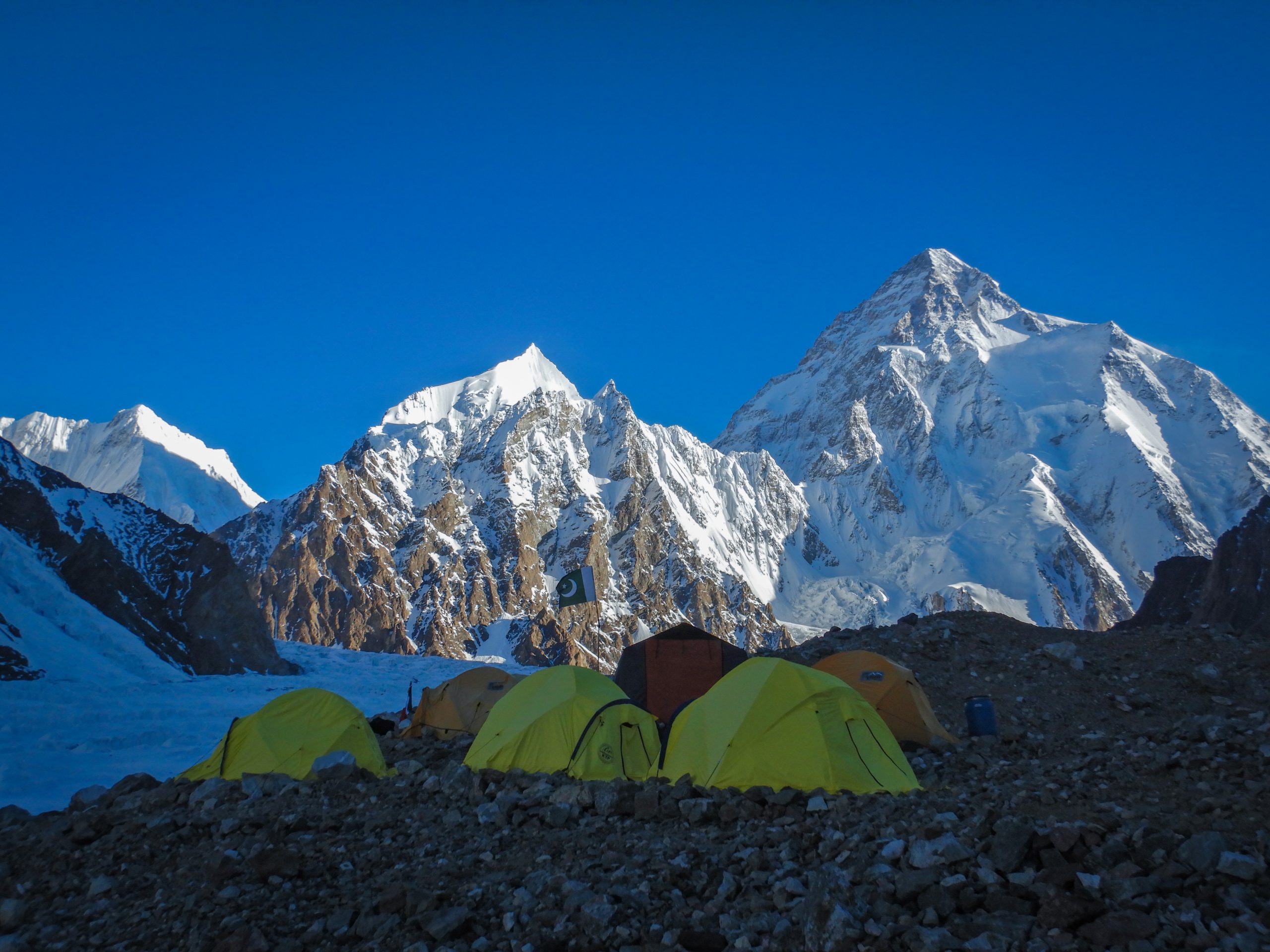
The K2 Base Camp Trek is one of the world’s most spectacular high-altitude trekking adventures, taking you deep into Pakistan’s Karakoram Mountains to the foot of K2 (8,611 m), the world’s second-highest peak. This 20-day expedition begins in Islamabad and continues through Skardu and Askole before following the Braldu Valley onto the legendary Baltoro Glacier. The journey leads through some of the most dramatic mountain scenery on Earth, culminating at Concordia and K2 Base Camp, approximately 5,150 metres above sea level.
The classic K2 Base Camp trekking route passes beneath the towering granite walls of the Trango Towers and Uli Biaho, with remarkable views of Paiju Peak, Masherbrum, Muztagh Tower and other great Karakoram summits. Beyond Paiju, the trail enters the rugged terrain of the Baltoro Glacier, crossing rocky moraine and glacial sections through remote camps at Khoburtse, Urdukas and Goro II. Each stage brings trekkers closer to the immense mountains surrounding the upper Baltoro.
One of the expedition’s greatest highlights is Concordia (approximately 4,600 m), a spectacular glacial junction surrounded by some of the highest mountains in the world. Here, the Baltoro and Godwin-Austen glacier systems meet beneath a remarkable panorama of peaks, including K2 and Broad Peak. From Concordia, the route follows the Godwin-Austen Glacier towards K2 Base Camp, bringing trekkers face to face with the scale and rugged beauty of the world’s second-highest mountain.
Saiyah Travel’s 20-day K2 Base Camp Trek follows the traditional Baltoro route, returning through Askole without crossing the more technically demanding Gondogoro La Pass. The itinerary includes a dedicated acclimatisation day at Paiju, carefully planned trekking stages and the support of local mountain guides, porters and expedition camping staff. Designed for physically fit trekkers with previous multi-day hiking experience, this challenging, non-technical expedition offers an opportunity to experience the remote wilderness of the Central Karakoram while reaching one of mountaineering’s most celebrated destinations.
Reach K2 Base Camp (5,150 m) beneath the world’s second-highest mountain.
Trek across the legendary Baltoro Glacier in the Karakoram.
Explore the remote Braldu Valley and Askole, the last permanent village.
Walk beneath the towering granite walls of Trango Towers and Uli Biaho.
Enjoy spectacular views of K2, Broad Peak and surrounding peaks from Concordia.
Admire iconic summits including Masherbrum, Muztagh Tower and Gasherbrum IV.
Camp among glaciers and some of the world’s highest mountains.
Experience the rich culture and hospitality of Baltistan.
Complete the classic K2 Base Camp route without crossing Gondogoro La Pass.
| Start Dates | End Dates | Price (USD) | Availability | Deposit | Registration |
|---|---|---|---|---|---|
| May 31, 2027 | June 19, 2027 | $2,100 | Available | $250 | Register Now |
| June 9, 2027 | June 28, 2027 | $2,100 | Available | $250 | Register Now |
| June 24, 2027 | July 14, 2027 | $2,100 | Available | $250 | Register Now |
| June 29, 2027 | July 18, 2027 | $2,100 | Available | $250 | Register Now |
| July 2, 2027 | July 21, 2027 | $2,100 | Available | $250 | Register Now |
| July 9, 2027 | July 28, 2027 | $2,100 | Available | $250 | Register Now |
| July 14, 2027 | August 2, 2027 | $2,100 | Available | $250 | Register Now |
| July 29, 2027 | August 17, 2027 | $2,100 | Available | $250 | Register Now |
| August 4, 2027 | August 23, 2027 | $2,100 | Available | $250 | Register Now |
| August 13, 2027 | September 2, 2027 | $2,100 | Available | $250 | Register Now |
| August 20, 2027 | September 9, 2027 | $2,100 | Available | $250 | Register Now |
Arrive at Islamabad International Airport, where Saiyah’s representative will meet you and arrange your transfer to the hotel. Islamabad serves as the starting point of the K2 Base Camp expedition and provides an opportunity to rest after your international journey.
Depending on your arrival time, the day will include an introductory briefing covering the trekking itinerary, mountain conditions, equipment requirements, and logistical arrangements. Your guide will review essential trekking gear before departure for Skardu.
The remaining time is free for rest and preparation for the journey into northern Pakistan.
DAY DETAILS
|
Altitude |
Approx. 540 m |
|
Activity |
Arrival, briefing and preparation |
|
Accommodation |
Twin-sharing hotel in Islamabad |
|
Meals |
As per arrival-day arrangements |
After breakfast, transfer to Islamabad Airport for the scenic flight to Skardu, the main gateway to trekking expeditions in the Karakoram Mountains.
The flight follows a dramatic route over northern Pakistan, with potential views of Nanga Parbat (8,126 m) and the surrounding mountain ranges when weather and visibility permit. On arrival in Skardu, transfer to the hotel.
The afternoon is available for rest, exploring the town, or purchasing any last-minute personal supplies. The trekking team will continue preparations for the journey toward Askole and the Baltoro Glacier.
|
Altitude |
Approx. 2,230–2,500 m, depending on location |
|
Transport |
Domestic flight, approximately 1 hour |
|
Activity |
Travel, rest and final preparations |
|
Accommodation |
Twin-sharing hotel in Skardu |
|
Meals |
Breakfast, lunch and dinner |
The expedition leaves Skardu in 4WD jeeps, travelling through the Shigar Valley and following the rugged mountain road toward the Braldu Valley.
The route passes traditional Balti settlements, steep-sided valleys, and dramatic river landscapes. As the journey progresses, roads become narrower and more challenging, giving the first indication of the remote terrain ahead.
Askole is traditionally the last permanent village on the classic trekking route to K2 Base Camp. Here, the trekking party meets the wider camp support team and makes final preparations before beginning the journey on foot.
The night is spent camping near Askole.
|
Altitude |
Approx. 3,050 m |
|
Driving time |
6–8 hours, depending on road conditions |
|
Transport |
4WD jeep |
|
Accommodation |
Twin-sharing expedition tent at Askole |
|
Meals |
Breakfast, lunch and dinner |
The first trekking day follows the Braldu Valley toward Jhola, marking the beginning of the journey into the high mountain wilderness of the Central Karakoram.
The trail passes rocky slopes, glacial streams, and the lower approaches of the Biafo Glacier. Beyond Askole, the landscape becomes increasingly isolated, with the Braldu River running through a broad valley beneath steep mountain walls.
Depending on the active trail, the route crosses the Dumordo River near its meeting with the Braldu before continuing toward Jhola. The team establishes camp alongside the valley, surrounded by a landscape of rock, rivers, and distant snow-covered peaks.
|
Altitude |
Approx. 3,150 m |
|
Trekking distance |
15–20 km |
|
Walking time |
6–8 hours |
|
Terrain |
Rocky trails, river valley and moraine |
|
Accommodation |
Twin-sharing expedition tent at Jhola |
|
Meals |
Breakfast, lunch and dinner |
Continue trekking through the Braldu Valley toward Paiju, one of the most important camps on the route to K2 Base Camp.
The route crosses exposed sections of rocky terrain and follows the river through an increasingly dramatic mountain landscape. As the valley opens, the remarkable granite formations of the Trango Towers begin to dominate the skyline.
Paiju is situated beneath Paiju Peak (approximately 6,610 m) and is one of the last established green camps before the expedition enters the Baltoro Glacier. Its relatively sheltered location makes it an important resting and preparation point for trekkers and support teams.
Arrive at Paiju and settle into camp for the next two nights.
|
Altitude |
Approx. 3,420 m |
|
Trekking distance |
19–21 km |
|
Walking time |
6–8 hours |
|
Terrain |
Rocky valley trails and exposed sections |
|
Accommodation |
Twin-sharing expedition tent at Paiju |
|
Meals |
Breakfast, lunch and dinner |
Today is reserved for rest and acclimatisation before entering the more demanding sections of the Baltoro Glacier.
Trekkers can spend the day recovering, hydrating, and taking short walks around camp according to their condition and the guide’s recommendations. The surrounding landscape offers outstanding views of Paiju Peak and the nearby mountain formations.
Meanwhile, the support team checks equipment, manages food supplies, and prepares for the coming days on glacier terrain.
The overnight stay at the same elevation provides additional time to adjust before the route climbs higher into the Karakoram.
|
Altitude |
Approx. 3,420 m |
|
Activity |
Rest, short walks and acclimatisation |
|
Walking time |
Optional short walks |
|
Accommodation |
Twin-sharing expedition tent at Paiju |
|
Meals |
Breakfast, lunch and dinner |
Leave Paiju and begin one of the defining sections of the K2 Base Camp Trek: the ascent onto the Baltoro Glacier.
The trail becomes noticeably more challenging as trekkers move across rocky moraine, uneven glacial debris, and sections of exposed ice. The landscape is dominated by towering granite formations, including the Trango Towers and Uli Biaho, among the most recognisable rock faces in the Karakoram.
The route traverses glacial terrain and passes close to the Liligo Glacier before continuing toward Khoburtse camp.
This is an important transition day, as the expedition moves from the relatively accessible lower valley into the vast glacier environment that characterises the approach to Concordia.
|
Altitude |
Approx. 3,800 m |
|
Trekking distance |
13–15 km |
|
Walking time |
6–8 hours |
|
Terrain |
Glacier moraine, loose rocks and ice |
|
Accommodation |
Twin-sharing expedition tent at Khoburtse |
|
Meals |
Breakfast, lunch and dinner |
The trek continues across the uneven terrain of the Baltoro Glacier toward Urdukas, one of the most scenic established camps on the route.
Although shorter than the previous day, the walk involves careful movement over moraine and glacial sections. Views open across the glacier toward the Trango Towers, Cathedral Peaks, and other impressive formations.
Urdukas is situated on the slopes above the Baltoro Glacier, offering a different perspective from the camps located directly on the ice.
The afternoon provides time to rest and enjoy the surrounding mountain views before the expedition moves toward the higher glacier camps.
|
Altitude |
Approx. 4,050 m |
|
Trekking distance |
5–7 km |
|
Walking time |
4–5 hours |
|
Terrain |
Glacier moraine and rocky slopes |
|
Accommodation |
Twin-sharing expedition tent at Urdukas |
|
Meals |
Breakfast, lunch and dinner |
Continue up the Baltoro Glacier, leaving behind the grassy slopes of Urdukas and entering an increasingly stark glacial environment.
The route crosses extensive moraine and sections of ice, with immense mountain walls rising on both sides of the glacier. Views may include Masherbrum (7,821 m), Muztagh Tower, and the surrounding peaks of the Baltoro Muztagh.
The trekking terrain requires sustained concentration as the team navigates unstable stones, ridges of debris, and changing glacier surfaces.
Goro II is an established glacier campsite where temperatures can fall sharply after sunset. With the expedition now above 4,000 metres, maintaining a steady pace and monitoring acclimatisation becomes especially important.
|
Altitude |
Approx. 4,300 m |
|
Trekking distance |
11–13 km |
|
Walking time |
6–8 hours |
|
Terrain |
Glacier, rocky moraine and uneven ice |
|
Accommodation |
Twin-sharing expedition tent at Goro II |
|
Meals |
Breakfast, lunch and dinner |
Today’s trek reaches Concordia, one of the most extraordinary locations in the Karakoram and a major highlight of the K2 Base Camp expedition.
The route continues along the upper Baltoro Glacier toward the meeting of some of the region’s great glacier systems. As the expedition approaches Concordia, the mountain landscape opens to reveal an immense amphitheatre of ice and rock.
Depending on visibility, trekkers can enjoy views of K2, Broad Peak (8,051 m), Gasherbrum IV, Mitre Peak, and numerous other remarkable summits.
Concordia is widely celebrated for its exceptionally concentrated mountain scenery. The first clear view of K2 from this area is often one of the most memorable moments of the journey.
Spend the night camping at Concordia, surrounded by the high peaks of the Central Karakoram.
|
Altitude |
Approx. 4,600 m |
|
Trekking distance |
11–13 km |
|
Walking time |
5–7 hours |
|
Terrain |
High-altitude glacier and moraine |
|
Accommodation |
Twin-sharing expedition tent at Concordia |
|
Meals |
Breakfast, lunch and dinner |
The expedition begins early for the final approach to K2 Base Camp, the main objective of the 20-day trekking journey.
Leaving Concordia, the route follows the Godwin-Austen Glacier toward the enormous southern face of K2. Trekkers move across challenging sections of moraine and glacial terrain, passing through a landscape shaped by the surrounding eight-thousand-metre mountains.
The approach passes the area of Broad Peak Base Camp before continuing toward K2 Base Camp, at approximately 5,150 metres.
As the team moves closer, the immense scale of K2 becomes increasingly apparent. Reaching the base of the world’s second-highest mountain represents the culmination of days of trekking through one of the most remote mountain regions in the world.
If weather, acclimatisation, campsite conditions, and expedition logistics permit, the team establishes camp in the K2 Base Camp area for the night.
|
Altitude |
Approx. 5,150 m |
|
Trekking distance |
11–13 km |
|
Walking time |
6–9 hours |
|
Terrain |
High-altitude glacier, moraine and loose rock |
|
Accommodation |
Expedition tent at K2 Base Camp area |
|
Meals |
Breakfast, lunch and dinner |
After breakfast, begin the return trek from K2 Base Camp to Concordia, retracing the route along the Godwin-Austen Glacier.
The morning offers another opportunity to appreciate the dramatic setting of K2 and its neighbouring summits. The return journey provides different perspectives of Broad Peak and the surrounding mountains as the expedition gradually descends toward Concordia.
Although the route loses altitude, walking remains demanding because of the irregular moraine and glacier surface.
Arrive back at Concordia for an overnight camp and prepare for the descent through the Baltoro Glacier.
|
Altitude |
Approx. 4,600 m |
|
Trekking distance |
11–13 km |
|
Walking time |
5–7 hours |
|
Terrain |
Glacier and rocky moraine |
|
Accommodation |
Twin-sharing expedition tent at Concordia |
|
Meals |
Breakfast, lunch and dinner |
Begin the return journey along the Baltoro Glacier, descending from Concordia toward Goro II.
The route offers a final opportunity to appreciate the great mountain panorama around Concordia before the expedition gradually moves into the narrower glacial corridor.
The descent follows familiar terrain, although the changing glacier surface requires continued attention. Views of Gasherbrum IV, Muztagh Tower, and Masherbrum remain prominent along sections of the route.
Arrive at Goro II for an overnight camp on the glacier.
|
Altitude |
Approx. 4,300 m |
|
Trekking distance |
11–13 km |
|
Walking time |
5–7 hours |
|
Terrain |
Glacier and moraine |
|
Accommodation |
Twin-sharing expedition tent at Goro II |
|
Meals |
Breakfast, lunch and dinner |
Continue descending the Baltoro Glacier toward Urdukas, crossing rocky moraine and sections of glacial terrain.
As the elevation decreases, the landscape begins to change, and the remarkable granite formations of the Trango Towers and Cathedral Peaks become more prominent again.
After several nights on the higher glacier, Urdukas provides a welcome return to a camp situated above the ice.
Spend the afternoon resting and enjoying views across the Baltoro Glacier.
|
Altitude |
Approx. 4,050 m |
|
Trekking distance |
11–13 km |
|
Walking time |
5–7 hours |
|
Terrain |
Glacier moraine and rocky slopes |
|
Accommodation |
Twin-sharing expedition tent at Urdukas |
|
Meals |
Breakfast, lunch and dinner |
Leave Urdukas and descend through the dramatic lower sections of the Baltoro Glacier toward Paiju.
The route passes beneath the immense rock faces of the Trango Towers and Uli Biaho, with numerous opportunities to photograph the surrounding mountains.
After navigating the glacier and its moraine, the expedition returns to the relatively greener surroundings of Paiju camp.
The lower altitude and familiar camp environment provide a welcome contrast to the exposed conditions of the upper glacier.
|
Altitude |
Approx. 3,420 m |
|
Trekking distance |
17–21 km |
|
Walking time |
7–9 hours |
|
Terrain |
Glacier moraine and rocky trails |
|
Accommodation |
Twin-sharing expedition tent at Paiju |
|
Meals |
Breakfast, lunch and dinner |
Continue the descent through the Braldu Valley, following the river downstream toward Jhola.
The trail passes through an expansive landscape of rugged cliffs, glacial streams, and mountain slopes. With the highest sections of the trek now behind, trekkers can enjoy the changing surroundings at a more comfortable elevation.
The route follows the same general valley used during the outward journey, with opportunities to see the terrain from a different perspective.
Arrive at Jhola and establish the final remote trekking camp before returning to Askole.
|
Altitude |
Approx. 3,150 m |
|
Trekking distance |
19–21 km |
|
Walking time |
6–8 hours |
|
Terrain |
Rocky valley trail and river crossings |
|
Accommodation |
Twin-sharing expedition tent at Jhola |
|
Meals |
Breakfast, lunch and dinner |
The final trekking day follows the Braldu Valley back toward Askole, completing the classic K2 Base Camp route.
The walk passes the lower approaches of the Biafo Glacier and continues through the rugged valley landscape toward the first permanent settlement on the return journey.
Arriving at Askole marks the end of the expedition’s trekking section. After days of walking through the Baltoro Glacier and the high mountains surrounding K2, the group reunites with the road transport team and prepares for the return to Skardu.
Overnight at Askole in expedition tents.
|
Altitude |
Approx. 3,050 m |
|
Trekking distance |
15–20 km |
|
Walking time |
5–8 hours |
|
Terrain |
Rocky mountain trails and river valley |
|
Accommodation |
Twin-sharing expedition tent at Askole |
|
Meals |
Breakfast, lunch and dinner |
After breakfast, leave Askole and travel by 4WD jeep through the Braldu and Shigar Valleys toward Skardu.
The return drive follows the rugged mountain road along the Braldu River, passing small settlements and dramatic landscapes before reaching the wider valleys of Baltistan.
On arrival in Skardu, transfer to the hotel. The remainder of the day is available for rest, a hot shower, and time to explore the town depending on the arrival hour.
Overnight at a hotel in Skardu.
|
Altitude |
Approx. 2,230–2,500 m |
|
Driving time |
6–8 hours, depending on road conditions |
|
Transport |
4WD jeep |
|
Accommodation |
Twin-sharing hotel in Skardu |
|
Meals |
Breakfast, lunch and dinner |
Transfer to Skardu Airport for the scheduled flight to Islamabad, subject to weather and airline operations.
The return flight offers a final aerial view of the great mountain landscapes of northern Pakistan before arriving in the capital. On arrival, transfer to the hotel.
The remainder of the day is available for rest, shopping, or independent sightseeing depending on the flight schedule.
Flight contingency: Domestic flights between Skardu and Islamabad are weather-dependent. If a flight is cancelled, alternative arrangements may involve waiting for a later flight or travelling overland, which ordinarily requires additional travel time. The final arrangements will depend on conditions and available days.
|
Altitude |
Approx. 540 m |
|
Transport |
Domestic flight, approximately 1 hour |
|
Activity |
Return to Islamabad |
|
Accommodation |
Twin-sharing hotel in Islamabad |
|
Meals |
Breakfast, lunch and dinner |
After breakfast, transfer to Islamabad International Airport according to your international flight schedule.
The K2 Base Camp Trek concludes after 20 days of travel and trekking through the Karakoram Mountains, including the Baltoro Glacier, Concordia, and the base of K2.
|
Altitude |
Approx. 540 m |
|
Activity |
Airport transfer and departure |
|
Accommodation |
Not included |
|
Meals |
Breakfast, subject to departure time |
The itinerary may be adjusted because of weather, road conditions, flights, local regulations, glacier conditions, or safety considerations.
Domestic return flight Islamabad to Skardu (20kg checked luggage; 7kg hand carry)
Airport transfers + Road transfers as per itinerary
Hotel stays in Islamabad and Skardu (twin-sharing)
Camp stays during the trek (twin-sharing)
Licensed professional trekking guide (English speaking)
Trekking logistics including tents, non personal equipment and support material
Porterage for personal equipment (17kg)
Porters and support staff wages
Food and tents during the trek (3 meals/day + tea/coffee)
Boiled Drinking water daily
Generator/Solar panels for electric supply
Satellite phone for emergency use
Basic medical kit for emergencies
Storage facility in Islamabad
Compulsory trekking permit fee ($150) + CKNP waste management fee ($190)
International flight
Pakistan entry visa (if applicable)
Lunch in Islamabad & Skardu
Previous night/early checkin in Islamabad (available on request)
Travel and medical insurance
Excess luggage during the trek ($12/kg)
Personal expenses (phone, internet, toiletries, laundry, soft drinks, alcohol)
Personal trekking gear and clothing
Special filming, camera, or drone fees
Extra porter if requested
Tips for guides, porters, and staff
Change of itinerary due to force majure reasons
Any other services not mentioned in the itinerary
The K2 Base Camp Trek is a strenuous high-altitude expedition that requires good physical fitness, hiking experience, and preparation for prolonged trekking in remote mountain terrain.
Although the classic route does not require technical mountaineering skills or a summit climb, trekkers must negotiate loose moraine, rocky trails, glacial ice, and exposed sections at elevations exceeding 4,000 metres.
The main challenges include:
Altitude: The route reaches approximately 5,150 metres, where reduced oxygen levels affect physical performance and increase the risk of altitude illness.
Long walking days: Several sections require six to nine hours of trekking, depending on conditions.
Glacier terrain: The Baltoro and Godwin-Austen Glaciers involve uneven surfaces, unstable rocks, and changing conditions.
Remote camps: There are no conventional trekking lodges along the high glacier route, and facilities are basic.
Weather: Snow, rain, strong winds, and freezing temperatures are possible even during summer.
The trek is best suited to hikers who have previously completed multi-day mountain treks and are comfortable walking for several consecutive days while carrying a personal daypack.
Technical climbing experience is not normally required for the standard K2 Base Camp route, but previous high-altitude trekking experience is strongly recommended.
Altitude is one of the most important considerations when planning a trek to K2 Base Camp.
The journey begins at approximately 540 metres in Islamabad and gradually climbs through Skardu, Askole, and the Baltoro Valley before reaching Concordia and K2 Base Camp.
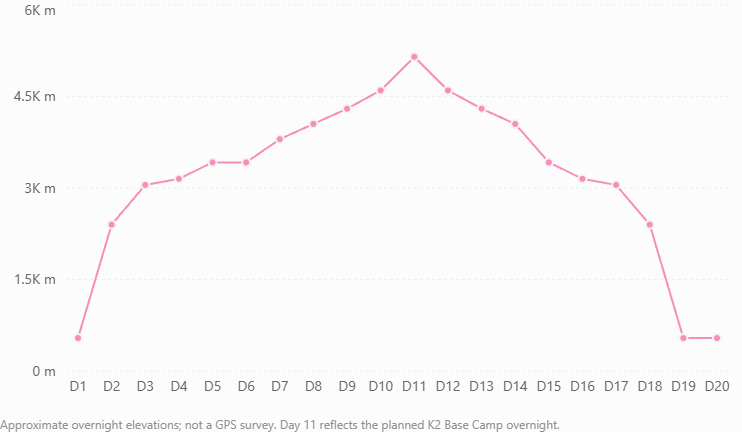
Our proposed itinerary includes a rest day at Paiju before the higher glacier sections. However, no trekking schedule can eliminate the risk of altitude sickness. In particular, the ascent from Islamabad to Skardu and the increase in sleeping altitude above 3,000 metres require careful attention.
Saiyah recommends that participants discuss their altitude-related medical suitability with a qualified healthcare professional before departure. Guides must be informed immediately about symptoms such as persistent headache, nausea, dizziness, or unusual fatigue.
The guide may modify the itinerary, arrange a descent, or stop an ascent when a participant’s condition requires it.
The main trekking season for K2 Base Camp generally runs from June to September, with July and August usually offering the most established expedition operating window.
|
Month |
Trekking conditions |
|---|---|
|
June |
Early-season conditions; more lingering snow and potentially difficult glacier sections |
|
July |
One of the main expedition months; generally suitable seasonal access |
|
August |
Popular trekking period, though rain and unsettled weather remain possible |
|
September |
Cooler temperatures, fewer trekking groups, shorter daylight and increasing late-season risks |
Weather in the Karakoram is unpredictable, and even during the main trekking season, conditions can change rapidly.
For most international trekkers, July and August are sensible months to consider, but departure dates should be planned around local conditions and operational readiness rather than weather expectations alone.
Careful packing is essential because the expedition involves prolonged trekking through different altitude zones, from comparatively warm lower valleys to freezing glacier camps.
Waterproof and windproof outer jacket and trousers.
Insulated down or synthetic jacket for cold evenings.
Thermal base layers and warm mid-layers.
Durable trekking trousers and moisture-wicking shirts.
Warm gloves, trekking socks, and a wool or fleece hat.
Sun hat, sunglasses with suitable UV protection, and neck protection.
Well-fitting, broken-in trekking boots with good ankle support.
Four-season-appropriate sleeping bag, rated for the expected campsite temperatures.
Comfortable daypack with a rain cover.
Trekking poles for steep and uneven terrain.
Headlamp with spare batteries.
Refillable water bottles or hydration system.
Personal first-aid supplies and prescribed medication.
Sunscreen, lip balm, and personal hygiene essentials.
Waterproof bags or dry sacks for protecting clothing and valuables.
Additional equipment requirements should be confirmed before departure according to the season, campsite conditions, and arrangements made by Saiyah.
Choosing the right trekking operator is essential for an expedition as demanding as K2 Base Camp. Beyond reaching the world’s second-highest mountain, a successful journey depends on experienced local personnel, carefully coordinated logistics, proper preparation and sound decisions in unpredictable mountain conditions.
Saiyah Travel is a Pakistan-based trekking operator specializing in journeys through the country’s remote mountain regions. We combine local expertise, professional expedition support and personalized planning to help trekkers experience the Karakoram with confidence.
Operating in the Karakoram requires more than following an established trekking route. Remote access, changing trail conditions, campsite logistics and the movement of supplies all demand careful coordination.
Our Pakistan-based team manages expedition arrangements, from mountain transportation and trekking permits to porters, camping logistics and local support, providing direct coordination throughout the journey.
The Baltoro Glacier presents demanding terrain where local knowledge and sound judgement are essential. Glacier conditions, river crossings and weather can change, making an experienced trekking team invaluable.
Our expeditions are supported by licensed, English-speaking trekking guides, local porters and dedicated camping staff who assist with route navigation, daily operations and group coordination throughout the trek.
Reaching K2 Base Camp at approximately 5,150 meters requires physical preparation, appropriate acclimatization and a realistic understanding of high-altitude trekking.
Our itinerary incorporates progressively higher camps and a dedicated acclimatization day at Paiju. Throughout the expedition, guides monitor participants’ wellbeing and adjust trekking plans when conditions or individual circumstances require.
Mountain weather, glacier conditions, road closures and flight disruptions can affect even the most carefully organized expedition.
Saiyah approaches these challenges with practical contingency planning, local coordination and clear communication. Our priority is to make informed decisions based on actual conditions rather than compromise safety to follow a fixed schedule.
Every trekker has different goals, experience levels and travel preferences. Alongside organized group expeditions, Saiyah offers customized K2 Base Camp treks for individuals, friends, private groups and trekking clubs.
We can tailor travel dates, trekking pace, acclimatization days and expedition arrangements to suit your requirements, subject to mountain conditions and operational feasibility. Our team works closely with you to develop a realistic trekking plan that balances your expectations with the demands of the Karakoram.
A successful K2 Base Camp Trek begins well before arriving in Pakistan. Understanding the route, preparing the right equipment and knowing what to expect are essential parts of the experience.
From pre-departure guidance and expedition preparation to on-ground coordination and the return journey, Saiyah provides direct assistance and straightforward communication, so you know what to expect at every stage of your adventure.
Deposit: The deposit is non-refundable, but it can be applied toward a future tour departure since it is used for in-country arrangements.
Balance Payment: The remaining balance is payable upon arrival in Pakistan on the first day of your tour. Detailed payment instructions will be provided ahead of time.
Currency: International travelers may pay in (USD) (EUR) (GBP).
K2 Base Camp is situated in the Central Karakoram Mountains of Gilgit-Baltistan, Pakistan, near the foot of K2 (8,611 m). The classic approach follows the Baltoro Glacier from Askole via Paiju, Urdukas, Goro II, and Concordia.
Our proposed itinerary takes 20 days from arrival in Islamabad to international departure.
K2 Base Camp is generally described as being approximately 5,150 metres (16,896 feet) above sea level. The precise elevation visited can vary depending on seasonal base-camp positioning and the chosen route.
The trek is considered strenuous because of its long walking days, remote location, high altitude, and uneven glacier terrain. It does not ordinarily require technical climbing skills on the classic route, but good fitness and prior trekking experience are important.
It is not recommended as a first multi-day mountain trek. Participants should ideally have experience trekking for several consecutive days and be comfortable walking over rocky or uneven terrain. Previous trekking at altitude is particularly useful.
The classic round-trip trekking route is commonly estimated at around 150–180 kilometres, depending on the camp locations, trail variations, and glacier conditions.
July and August are generally the main trekking months, although organised expeditions can operate during other suitable periods between June and September. Conditions vary from year to year.
The trek involves significant risks associated with altitude, harsh weather, glacier travel, falling rocks, and remoteness. Experienced support teams and proper preparation can help manage these risks, but they cannot eliminate them.
Yes. The K2 Base Camp route passes through a regulated mountain region where applicable trekking permissions and fees are required. Requirements and charges can change, so current documentation should be confirmed before departure.
Foreign trekkers should not assume that they can enter the regulated Baltoro and K2 region independently without approved local arrangements. Permits, guide requirements, and support logistics must be checked according to current rules.
Hotels are available in Islamabad and Skardu, but the classic trekking route beyond Askole relies on expedition camping. There is no continuous network of mountain teahouses or trekking lodges comparable to some popular Himalayan routes in Nepal.
K2 Base Camp is generally more remote and logistically demanding, involving longer stretches without permanent accommodation and extensive travel across glacier moraine. Everest Base Camp is also a serious high-altitude trek, but its popular Nepal route has more established tourist infrastructure.
Yes. Concordia is one of the main locations along the route offering remarkable views of K2 and surrounding mountains, provided visibility is clear.
No. Saiyah’s standard 20-day itinerary follows the traditional Baltoro Glacier route to K2 Base Camp and returns through Askole. Gondogoro La is a separate, more technically demanding route option.
Yes, private expedition arrangements can be requested for individuals or groups. Dates, support services, and costs depend on the group requirements and operating conditions.
Ready to take on one of the world’s most extraordinary high-altitude adventures? Saiyah Travel’s K2 Base Camp Trek 2027 offers the opportunity to explore Pakistan’s spectacular Karakoram Mountains with experienced local guides and professionally coordinated expedition support.
Whether you’re joining a scheduled departure or planning a private K2 Base Camp Trek, our Pakistan-based team can help you choose suitable travel dates, prepare for the expedition and customise arrangements around your trekking experience and preferences.
Start planning your K2 Base Camp adventure with Saiyah Travel. Contact our team to check 2027 availability, discuss your requirements and receive a personalised trekking proposal.

This was a remarkable journey through one of the world’s most beautiful mountain regions. I particularly enjoyed trekking across the Baltoro Glacier and spending time at Concordia. The team’s local knowledge and expedition support made the experience special